
About
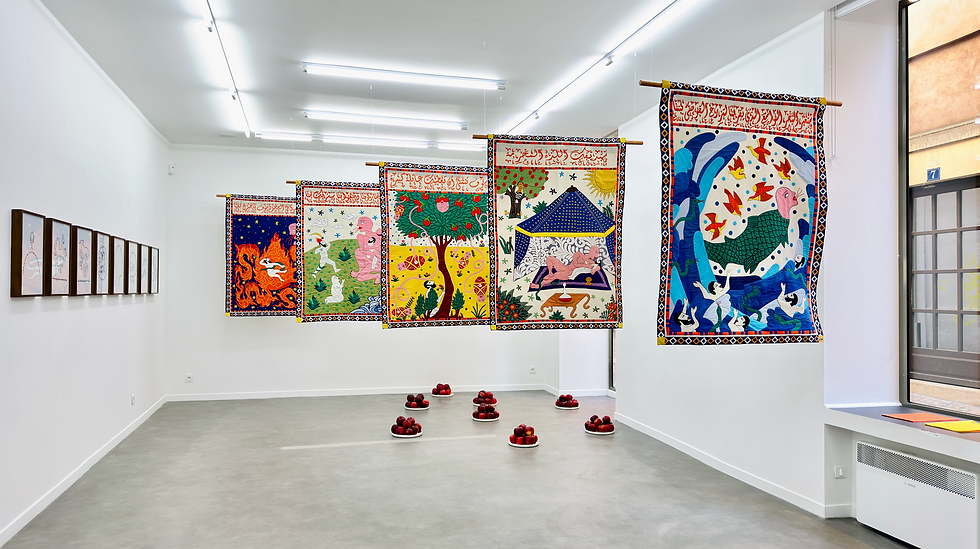
Serpents, Genies, Chimeras and Other Wonders unfolds as a constructed world inhabited by hybrid feminine figures—unstable bodies that resist fixity and exist in a space where categories lose their stability. What is at stake here is not an attempt to define femininity, but rather to inhabit the gap between what is expected of it and what continually escapes those expectations. These figures do not illustrate mythology; they operate within it, as a living field in which forms are constantly transformed, displaced, and reconfigured.
The genie, the chimera, and the serpent are not motifs but states of being. They give form to modes of existence that do not coincide with themselves, bodies that are multiple, reversible, and traversed by contradictory logics. They appear at the point where distinctions—between human and non-human, unity and multiplicity, identity and transformation—begin to break down. In this sense, they are not marginal figures, but rather operators that reveal the instability at the core of any system of classification.
Within this framework, femininity emerges not as a subject to be represented, but as a particularly exposed surface: a site onto which norms, expectations, and inherited narratives are projected. Rather than opposing these structures directly, the works displace them from within, introducing fissures, duplications, and slippages that unsettle their apparent coherence. What is at play is a condition of non-coincidence: existing in the world without ever fully aligning with the form one is supposed to inhabit, not as a deficit, but as an active and generative state.
The Chimera series brings this condition into focus through composite bodies that hold multiplicity without resolving it, where dual or bifurcated forms coexist within a single figure and sustain contradiction as a mode of existence. In The Jinny from the West, forms become more unstable and proliferative, extending beyond their own contours and introducing a figure of alterity that cannot be assimilated, remaining in excess of any stable reading. The Ḥayāt al-Ḥayāt series, through the recurring figure of the serpent, unfolds a logic of continuous transformation, where the body moves through undulation, shedding, and renewal, displacing fertility from reproduction toward a more open field of potentiality.
In this sense, the work can be understood as queer—not as the expression of an identity, but as a way of inhabiting the world that resists assignment and sustains indeterminacy. It produces forms that refuse to stabilize, that remain in tension, and that displace the conditions through which bodies are usually made legible. What emerges is not a unified narrative, but a field of shifting relations, where identity is neither given nor achieved, but continuously negotiated through transformation.
To inhabit this world is not to find a place within a fixed structure, but to remain within movement, contradiction, and multiplicity—to exist in the in-between without seeking to resolve it.


